By looking all around the UNCG campus, as well as Greensboro, I have learned a lot about how cities grow and change over time. Over time the campus which we live on has grown as was needed, and is planned to continue growth along its fronts to become even larger. Different sections of campus have unique beats to them, and even individual buildings can have beats. There are areas of high activity, as well as places kept hidden because they are not that visually appealing, such as the smoke stack. Individuals can also view parts of the campus in their own unique ways, and vantages can still be up for personal interpretation. The buildings have changed in style in the more modern era, although some were designed to resemble the original campus buildings. It is interesting why some should be built to look more historic, and others more modern. It creates a bit of a hodge-podge of architectural styles across campus.
When looking around the rest of Greensboro there is a similar situation, but on a much larger scale. The city is also divided into even more different sections, each with their own aura. The college residential areas are different from the old mill villages, which are also very different from the apartment buildings downtown. Each retail section is set up in a different way. The mall is very different from the Friendly Shopping Center, and the strip malls along Lee St and Wendover Ave. As the town expanded values changed and old buildings were put to different uses. WAFCO mills turned into 28 apartments, and the old Presbyterian Church turned into a museum, the train station moved to The Depot.
All of these many changes are typical for any city that has grown and changed over the years. Values changes, the needs of citizens change, areas go from rural to industrial to residential. It is happening all over America and I am now able to see the signs of these changes while walking around town. Exploring some of the individual changes that are very influential to how the city functions today could be something I might include in my final project. It will be very interesting to see if when I go back to Jersey if I will begin to see my hometown in a new and different way from now on, without the old fixes.
Sunday, November 15, 2009

Big Field Trip - Open Space
Battleground Park is placed on the located on a Revolutionary War battle site. There are many monuments to distinctive figures, such as Joseph Morehead, William Hooper, John Penn. The largest monument by far however is of Nathanial Greene, for whom Greensboro is named. These are all very representative of the values of the area, and show how important this site was to the War.


The fact that this area was left as open space instead of being developed into a continuation of the rest of the town shows some of the values of the Greensboro organizers. It is very important to have some undeveloped area that is open to the community. This space is ideal for families to go to in order to get away from the city if they desire. There are bike and walking trails, which are great for outdoor exercise and many people were using them to walk their dogs. The space allows a healthier alternative to many people's daily living situations. There is fresh air and natural light, that those people living in apartments may not have adjacent access to. There are informational signs at the entrances that might be helpful for tourists in the area, which would be very beneficial to the town for extra revenue.

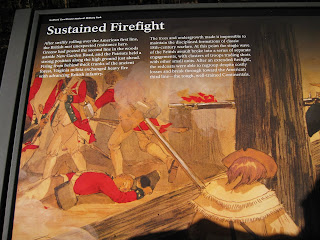


The fact that this area was left as open space instead of being developed into a continuation of the rest of the town shows some of the values of the Greensboro organizers. It is very important to have some undeveloped area that is open to the community. This space is ideal for families to go to in order to get away from the city if they desire. There are bike and walking trails, which are great for outdoor exercise and many people were using them to walk their dogs. The space allows a healthier alternative to many people's daily living situations. There is fresh air and natural light, that those people living in apartments may not have adjacent access to. There are informational signs at the entrances that might be helpful for tourists in the area, which would be very beneficial to the town for extra revenue.


Big Field Trip - Residential
The White Oak Mill is still in use, and while the surrounding village is not the same as it was when it was first built, it still resembles the 'mini-town' it was set up to be. It is easy to tell that this residential section was planned out and built all at the same time. The streets are set up in a grid and the streets are numbered instead of having different names. Each house is fairly small and has a similar basic structure with a chimney in the middle of the building. Many of the current residents have added their own small additions, such as carports and porches, to the main section of the house. As the mill was renovated, the surrounding residential areas became more renovated too. There are no sidewalks in this development, showing that it was built to be a practical, affordable living situation for the mill workers, instead of a social area. The mail boxes are also placed along the road instead of by the front doors, showing that it is not meant to be an especially personable area. There is also a lot more space between the houses than between the different residences in the main part of town, and there are few large trees since the houses were built in the middle of an open field and only some residents decided to plant their own foliage.

The Revolution Mill has been renovated for a new purpose, but pieces of the surrounding village still remain. There is the Revolution Masonic Lodge, Baptist Church, and Buffalo Presbyterian Church all along Church Street which runs into downtown Greensboro. There is an iron-fenced cemetery belonging to the Cone family, which was a very prominent family early on in Greensboro. These buildings are all built in the classical style.


In stark contrast to all of the mill residences is the Lowenstein residence. It was built in 1954 and designed by Edward Lowenstein for his own wife and family. The windows are designed specifically for North Carolina weather, to maximize the sun during the winter and minimize it during the summer. The house is divided into 'zones' with space to move between them. The kitchen and dining room take up one end, with a front foyer and living room in the middle, and both the children's and master bedrooms occupying the other end separated by a long, skinny hallway to divide the public and private sections of the house. The house is designed to be very warm, welcoming, and comfortable. The walls are wood paneled, and the owners' book and art collections can be viewed throughout the house. The large windows allow the house to seem as if it mixes both the indoors and outdoors together in one area.


The shape of this building is very unique, as is the incredible artwork outside in the yard. There is an exploding plane piece, a large pearl necklace, as well as many others. The chimney is also located out in the yard, which is quite unusual.


Big Field Trip - Roadways
Since I was driving, and often times trying to catch up to re-join the caravan, please excuse me if this blog is in any way lacking...
I-40 between High Point Rd and Wendover Ave
This stretch of the interstate was just flat and open, with exits branching off, but nothing directly accessible from the road. There was not a strong sense of community along this road, but it was more as if it was a connector between communities.


Wendover Ave
There are large mass production stores, such as Wal-Mart, restaurant, Tripps, and car dealerships, Volks Wagon, along Wendover Ave. There are also gas stations, Sheetz, and fast food places, Burger King, banks, Wells Fargo, and cell phone companies, AT&T and Verizon. This stretch has a lot of retail all along the highway, with many traffic lights and entrances to the bigger stores right off the road. The road shows that it was a cross section because of the close proximity of everything to the street, instead of larger open spaces.


Battleground Ave from South to North
Battleground did not seem as crowded as Wendover, it still crossed through previously established areas, although these areas were more residential rather than consumer oriented. I don't really remember much about this road, but I remember there being more trees.
Big Field Trip - Retail
On this trip we viewed three different retail areas; Old Friendly Center, Four Seasons Mall, and New Friendly Center. All three sections seem to be catering to the upper middle-class demographic. The new section of Friendly Center seems to have the most expensive shops, and each storefront is completely unique to the individual store. The Four Seasons mall has a mix of stores, with some expensive ones, as well as some that are less expensive. There was a very large variety to choose from, all in a small, enclosed space. There was also a large presence of jewelry stores, of which there was about one jewelry store in each section of the Friendly Center. The older section of the Friendly Center had more chain stores, that typically have a lower price range. There were also more stores that were geared toward children than the newer section. All of these areas seemed to be very family-friendly. There was a noticeable presence of security in all three which would make shoppers feel safe to bring their entire family there.
The Friendly Center is much more spread out since the store front are all facing outwards towards the parking lots. There is a lot of parking available, and some stores even have spaces just on the other side of the sidewalk in front of the front doors. There are medians out in the middle of the lots with trees and tables with chairs for shoppers to go sit at.

This center is cornered by three large stores; Sears, Belk, and Macy's. It is accessible from all four surrounding streets; Friendly Ave, Pembroke Rd, Northline Ave, and Green Valley Rd. Most of the stores have a very similar face, with the exception of the New York & Co. and Bear Rock Cafe.


Other than stores there are places to eat, and around the perimeter. The newer section of Friendly Shopping Center is also easily accessible, but has less organization. It is mainly clothing shops and places to eat, with a large Harris Teeters right in the middle. While it is within walking distance of the older section, there does not seem to be very much continuity between the layout of the two areas.

In contrast to both sections of the Friendly Center, the Four Seasons mall has all of its stores inside of one building. There is a large amount of parking around the perimeter of the building, but it has no large foliage or areas for shoppers to go outside to sit and eat. Everything is indoors, and it is very easy to get from one store to another quickly. In addition to the larger stores, there are also small kiosks in the middle of the walkways selling things like jewelry, cell phone accessories, and custom apparel. The mall is located just off High Point Rd, which is a very busy route.

Monday, November 9, 2009
"If John Keats Had Twittered: Expressions of Love in the Age of Facebook"
In this session of "Food for Thought" Dr. Lollie White and E.D. Kennedy discussed how communication in the form of letter writing used to be the social norm, and how it has been replaced by today's new technology for both young and old. Dr. Lollie White is a large fan of John Keats and described how much he wrote to his love, Fannie Braun, and the efforts he went through to stay in touch with her. Dr. White told about how important it was to her, even today, that she receive a written letter from someone as opposed to an email. Taking the time to handwrite your thoughts to someone, especially a significant other in the form of a love letter, can be so much more special to someone than just sending an email of facebook comment.
Kennedy took over the second half of the talk and gave her view on today's new technology. She has no problem with the many new ways to communicate over larger distances, but prefers letter writing herself. Kennedy does not wish to learn how to use computers and email, and still maintains active communication with old friends in Texas through snail mail. She also talked about how important letter writing was during war time, and how that was her only way to communicate with her husband while he was in the service. He felt sentimental enough about all the letters that she wrote to him, that he saved them all, and now she is able to look back on what she wrote to him so long ago, and regrets not having kept the letters that he wrote back to her.
The speakers polled the students listening throughout the discussion about how they communicate with others these days. Very few actually write letters anymore, and many use facebook. Few students had twitter, but many have used skype before. The speakers had not heard of skype before, and were very interested to learn about a way to video chat with others, even those overseas. I feel that as important as communication is to me, online sources are great for urgent messages that need to get to someone quickly, or random thoughts that are fairly unimportant. After sitting in on this discussion I am somewhat inspired to write a letter to those who are important to me and see what happens...

Wednesday, October 28, 2009
Tracing the Tracks: Opening the Gates
The train originally helped to bring industry for the first time to the Greensboro area. This helped the area develop quickly, since the train was the fastest way at the time to move large amounts of materials and people directly into the city. The train continued to fuel the industries in the area as time went on, as it was easy to bring in raw materials and send out the finished products to many areas quickly. Presently there is less need for the train for industrial purposes so a few of the branching out tracks are no longer in use and the main train station was moved to be closer to town so that people could get to the trains more easily. Now the trains are a very easy way to move from one place to another within North Carolina, and from there anywhere in the country if a person so desires.

The interstates that run through Guilford County, such as I40 and I85 are also easy ways to enter the area and are also Gates to the city. Aside from ground transportation, Piedmont Triad International Airport provides air transportation to many different places and is very close by.
Location listing; Atlanta, Charlotte, La Guardia, Philadelphia, Chicago, Newark, Wash. Dulles (IAD), Cincinnati, Dallas, Detroit, Houston, Wash. National (DCA), Orlando Sanford, St. Pete/Clearwater, Memphis, and Miami.
Subscribe to:
Posts (Atom)
